
Everyone’s buzzing about ChatGPT these days. From tech enthusiasts to those less familiar with AI, the question on everyone’s mind is: “How does it actually work?” I’ve noticed a lot of my non-technical friends and family asking me about the magic behind it, so I wanted to break down the basics of ChatGPT without diving into complicated programming details.
The launch of ChatGPT in November 2022 was a watershed moment. Its rapid adoption even spurred tech giants like Google to accelerate the development of their own language models, like Google Bard. This quick adoption highlights the impact of generative AI on various industries.
How it works:
At its core, ChatGPT is designed to generate text that seems like a natural continuation of what it has already “read.” Think of it as trying to guess the next word in a sentence based on a massive amount of training data – billions of web pages, books, and articles.
Imagine you’re playing a word association game. You hear the phrase “peanut butter,” and your mind might jump to “jelly.” ChatGPT does something similar, but on a much larger scale. It uses machine learning to analyze probabilities of different words following each other, which helps it create realistic and sensible sentences.
The process goes something like this: the system is trained on a huge corpus of text and will statistically determine the probability of a word or sequence of words. So if you provide the prompt: “AI will…”, based on the training data set, the system will predict a likely continuation of the sentence such as: “AI will change the world”
| Sentence | Next Word.. | Probability |
| The cat sat on the | mat | 0.5 |
| couch | 0.4 | |
| roof | 0.3 | |
| floor | 0.2 |
Now, let’s say we start with the phrase “The cat sat on the…” ChatGPT scans its vast knowledge base (built from all that training data) and identifies potential words that could follow, such as “mat,” “couch,” or “roof.” But here’s the clever part: it doesn’t just pick the most likely word.
Instead, it generates a ranked list of words with associated probabilities. The remarkable thing is that when ChatGPT writes something like an essay, it’s essentially just asking over and over again “given the text so far, what should the next word be?” and each time adding a word.And the remarkable thing is that when ChatGPT does something like write an essay, what it’s essentially doing is just asking over and over again “given the text so far, what should the next word be?” — and each time adding a word.
The “Creativity” Factor: A Touch of Randomness
Here’s where things get interesting. If ChatGPT always chose the most probable word, its writing would be predictable and, frankly, a bit boring. It might sound robotic and lack any spark of creativity.
To avoid this, ChatGPT introduces a degree of randomness. It sometimes picks words lower down on that probability list, injecting an element of surprise and making the text feel more human. This is why you can give ChatGPT the same prompt multiple times and get slightly different results each time.
Think of it like this: imagine you’re ordering ice cream. The most “likely” flavor might be vanilla, but sometimes you want to be adventurous and try something like raspberry swirl. The randomness in ChatGPT allows it to take those “raspberry swirl” chances in its writing.
This randomness is controlled by a parameter often called “temperature.” Higher temperatures mean more randomness, leading to more surprising (and sometimes nonsensical) results. Lower temperatures mean more predictability. Experimenting with the temperature setting is how you get a balance between coherence and creativity in the AI’s output. There’s no set formula or theory to determine the best temperature – it’s something you experiment with to see what gives you the result you want.
In a Nutshell:
ChatGPT isn’t magic, but it’s certainly impressive. It’s a sophisticated language model that uses machine learning and a dash of randomness to generate text that’s both coherent and (sometimes) creative. I hope this simplified explanation helps you understand the basics without getting lost in the technical weeds.
A Brief History of GPT:
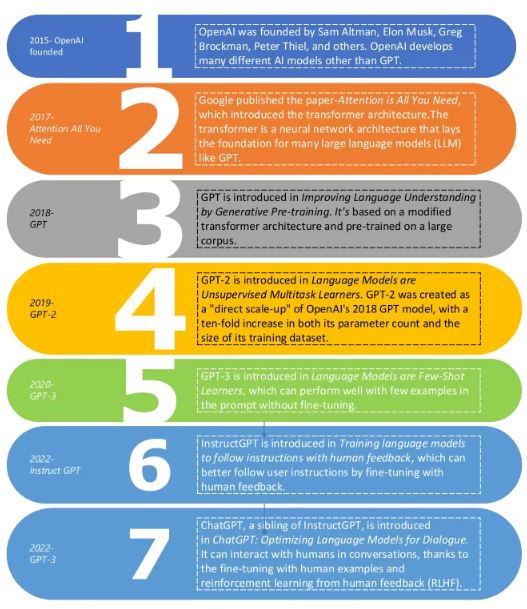
ChatGPT is the latest in a series of language models developed by OpenAI, a research organization founded in 2015 with a focus on AI. From its early iterations to its current form, GPT has evolved significantly. Here’s a quick timeline of the models that led to ChatGPT:
[Here you can then provide a brief and concise timeline, mentioning key versions like GPT-1, GPT-2, GPT-3, and ChatGPT, highlighting significant improvements in each iteration.]
I hope the above information helps you to understand the evolution of ChatGPT and how it works without too much technical jargon.