
You’ve learned how to clean data and build models. But here’s the truth: a model that works perfectly on your laptop might fail miserably in the real world.
In this final module, we’re going to look at how to move from “it works on my machine” to “it works for everyone, safely and accurately.”
6.1 Overfitting and Underfitting: The “Exam Prep” Problem
Imagine you’re studying for a history exam.
- Overfitting (The Memorizer): You memorize every single word of the practice test. You get 100% on the practice, but when the real exam has slightly different questions, you fail. The model is “too flexible”—it learned the “noise” (random details) instead of the actual pattern.
- Underfitting (The Slacker): You only read the table of contents. You don’t know enough to pass the practice test or the real exam. The model is “too simple” to see the pattern.
The Bias-Variance Trade-off
- High Bias (Underfitting): The model has pre-conceived notions and ignores the data. It’s too stubborn.
- High Variance (Overfitting): The model is too sensitive. It changes its mind based on every tiny, irrelevant detail in the data.
How to fix it:
If you’re overfitting, try using simpler models or more data. If you’re underfitting, your model needs to be more complex.
6.2 Cross-Validation: The “No-Cheating” Evaluation
Until now, we’ve used a single “Train-Test Split.” But what if that 20% we chose for testing happened to be the easiest data points in the whole set? Our accuracy score would be a lie.
K-Fold Cross-Validation solves this.
- Instead of one split, we divide the data into, say, 5 groups (Folds).
- We train the model 5 different times.
- Each time, a different group acts as the Test set while the other 4 act as the Training set.
- We average the results.
This gives us a much more honest “Grade Point Average” for our model. It’s like taking five different practice exams instead of just one.
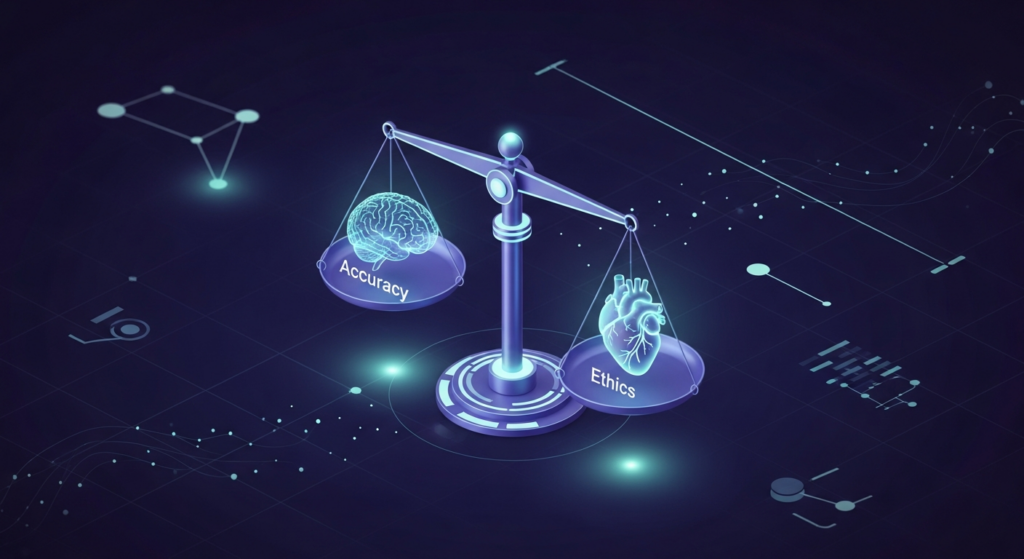
6.3 Ethical AI: Because Models Impact Lives
Machine Learning isn’t just math; it’s a tool that makes decisions about people.
1. Data Bias: “Garbage In, Bias Out”
If a bank uses a model to decide who gets a loan, and they train it on 50 years of data where women were rarely given loans, the AI will “learn” that women are bad candidates. The AI isn’t sexist, but the data is.
2. Fairness & Transparency
Can you explain why the AI rejected a job application? If an AI is a “black box” that nobody understands, it’s hard to hold it accountable.
3. Privacy
Are we using data that people didn’t agree to share? Just because data is available doesn’t always mean it’s ethical to use it for training.
The Reality Check: As a developer, your job is to constantly ask: “Who might this model hurt?”
6.4 The Future: Where do you go from here?
You now have a solid foundation. Here is a map of the “Advanced” world:
- Deep Learning & Neural Networks: Inspired by the human brain. This is what powers self-driving cars and face recognition.
- Natural Language Processing (NLP): Teaching computers to understand human speech and text (think ChatGPT or Siri).
- Computer Vision: Teaching computers to “see” and understand images and videos.
- Reinforcement Learning: Learning through trial and error (like a robot learning to walk or an AI learning to play chess).
🛠 Final Thought: The “Continuous Learning” Mindset
Machine Learning changes every single month. The most successful people in this field aren’t the ones who know the most code; they are the ones who are the best at problem-solving and asking the right questions.
Your Final Challenge:
Look at a problem in your daily life—your commute, your grocery shopping, or your workout routine.
- What data would you need to collect?
- Is it a Regression or a Classification problem?
- How would you know if your model was being “fair”?
Congratulations!
You’ve completed the course. You started with raw data and ended with the ability to build, evaluate, and think critically about Artificial Intelligence. Go build something great!